
By Bavoriat Clara
The Chief of Defence Staff (CDS), General Olufemi Oluyede, has reiterated the Armed Forces of Nigeria’s commitment to a security framework that places the safety of civilians, respect for human dignity and national unity at the centre of military operations.
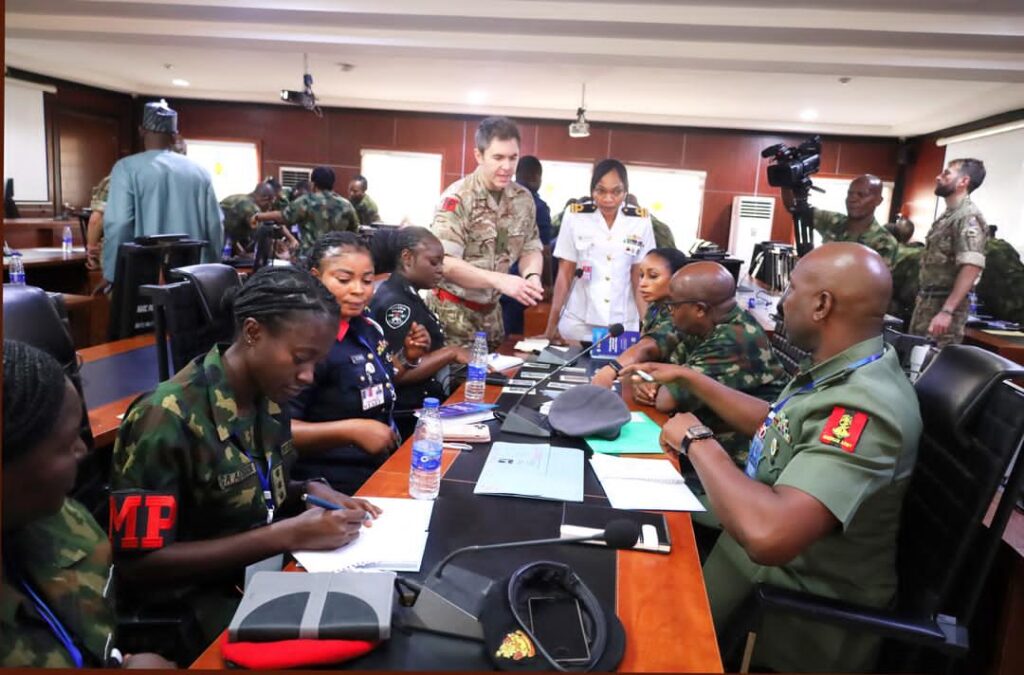
General Oluyede stated this at the opening of the Human Security and Gender Advisers Course at the Nigerian Army Resource Centre, Abuja, stressing that human security and gender perspectives have become critical components of modern military effectiveness.
Represented at the event by the Chief of Defence Standards and Evaluation, Major General Ibrahim Lessa, the CDS highlighted the importance of people-focused strategies in addressing Nigeria’s evolving security challenges. He expressed appreciation to the United Kingdom for its continued support in building the professional capacity of the Armed Forces of Nigeria, particularly through cooperation in Civil-Military Cooperation activities.
According to him, the long-standing defence relationship between Nigeria and the United Kingdom reflects a shared understanding of contemporary security realities, noting that the contributions of the British Defence Staff have significantly enhanced the operational performance of Nigerian forces.

General Oluyede observed that Nigeria’s security landscape has grown increasingly complex, with threats ranging from insurgency and violent extremism to communal clashes, transnational crime and humanitarian crises. He explained that these challenges directly affect civilian populations, making it imperative for security responses to go beyond conventional combat operations.
He noted that sustainable peace and stability can only be achieved through inclusive and preventive measures that address the underlying causes of conflict, adding that the confidence and cooperation of local communities remain essential to mission success.
The CDS further explained that the Human Security and Gender Advisers Course aligns with his strategic vision of strengthening the Armed Forces through enhanced joint operations, improved welfare and efficient administration within a whole-of-government approach. He said the goal is to build a military that is not only operationally effective, but also ethically sound, socially responsive and sensitive to the environments in which it operates.
He emphasised that the protection of civilians, collaboration with civil authorities and preventive engagement are now core elements of military effectiveness, describing human security and gender considerations as fundamental to operational legitimacy and long-term success.

General Oluyede urged participants to maximise the training opportunity by actively engaging in discussions and knowledge sharing, noting that the lessons learned should be applied in operational planning, field operations and interactions with civilian communities. He added that participants are expected to serve as drivers of positive institutional change within the Armed Forces and other security agencies.
Earlier, the Chief of Defence Civil-Military Relations, Rear Admiral Saburi Lawal, welcomed participants to the course, which is jointly organised by Defence Headquarters in partnership with the British Defence Staff. The programme is scheduled to run from 26 January to 4 February 2026.
Rear Admiral Lawal described the course as another significant step in the enduring defence cooperation between Nigeria and the United Kingdom, saying the partnership has continued to strengthen capacity development across the Armed Forces and other security institutions.
He disclosed that participants were carefully selected from the Armed Forces of Nigeria, the Nigeria Police Force and the Nigeria Security and Civil Defence Corps, noting that they are expected to serve in advisory roles that will help improve professionalism, inter-agency collaboration and trust between security forces and the civilian population.
The course is designed to enhance participants’ understanding of human security and gender dynamics in operations, strengthen civil-military relations and reinforce people-centred approaches as a key pillar of Nigeria’s national security strategy.
 admin
admin